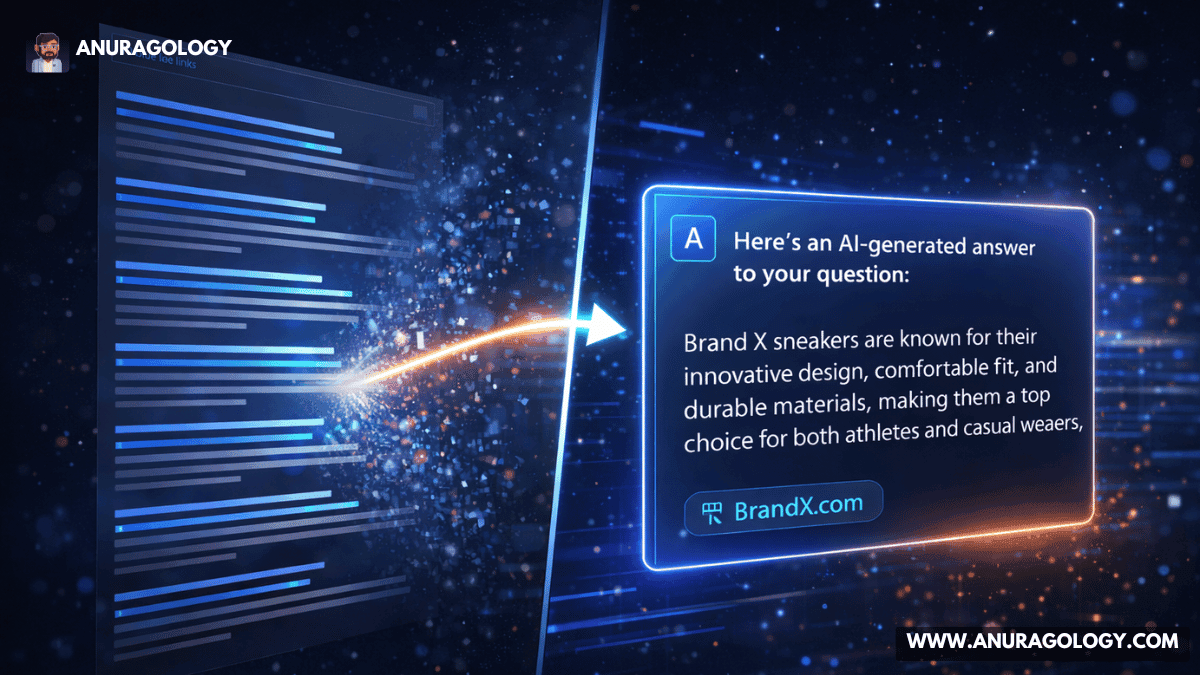
The digital marketing world is currently in a state of panic, and the data explains why.
In 2026, traditional search engine volume has dropped significantly, and over 60% of all Google searches now end in a "zero-click." A user types a question, an AI Overview or a chatbot (like ChatGPT or Perplexity) generates a synthesized answer instantly, and the user never clicks through to a website.
For marketers who have spent the last decade fighting for the #1 ranking on Google to drive traffic, this feels like an apocalypse.
But it isn't. It is simply an evolution. The goal of search marketing has fundamentally shifted. We are no longer optimizing just for clicks; we are optimizing for citations. If you are not referenced by Large Language Models (LLMs) and AI search engines, your brand practically does not exist in the modern buyer's journey.
Welcome to the era of Generative Engine Optimization (GEO).
SEO vs. GEO: What is the Difference?
To win in 2026, you have to run a dual strategy. You cannot abandon Search Engine Optimization (SEO), but you must layer GEO on top of it.
- Traditional SEO is about capturing transactional, high-intent clicks. It focuses on keyword density, backlinks, and cracking the algorithm to rank high in the traditional search results.
- GEO (Generative Engine Optimization) is the practice of structuring your content and brand footprint so that AI models choose your data to generate their answers. It focuses on topical authority, factual density, and making your content easily "extractable" for machines.
When you win at GEO, your brand is the one named as the authoritative source inside the AI summary. Even if the user doesn't click immediately, you win the "zero-click" awareness layer where buying decisions are now framed.
The Anuragology 4-Step GEO Playbook
Getting AI to cite your brand requires a completely different approach to content creation. AI engines do not care about your clever marketing copy; they care about clear, structured, and verifiable facts. Here is how to adapt.
1. Optimize for "Extractability" (The Quick Answer Method)
AI systems scrape the web looking for the clearest, most direct answer to synthesize. If your blog post buries the answer under five paragraphs of fluffy introduction, the AI will skip your site and pull from a competitor.
- The Fix: Open every major section of your content with a 40–80 word "Quick Answer" that directly addresses the core query.
- Structure is King: Use H2 and H3 tags formatted as the exact questions your users are asking. Immediately below the heading, use bullet points, numbered lists, or short, punchy paragraphs. The easier it is for an AI parser to read, the more likely you are to be cited.
2. Publish Original Data (Become the Source)
LLMs are desperate for hard data, statistics, and original research. They are programmed to prioritize "Information Gain"—new, unique insights that cannot be found anywhere else on the web.
- The Fix: Stop writing generic "Ultimate Guides" that just recycle what is already ranking. Start publishing original case studies, industry surveys, and proprietary data. If you publish a report titled "The State of D2C Marketing in India 2026" and include original charts and percentages, AI models will use your statistics to answer user queries, linking back to your brand as the primary source.
3. Build "Off-Site" Entity Authority
Traditional SEO relied heavily on you optimizing your own website. GEO relies heavily on what other people say about you. AI engines do not just read your blog; they scan Reddit, Quora, LinkedIn, G2 reviews, and industry publications to figure out if you are actually an authority.
- The Fix: You must build an omnipresent "Entity Footprint." Encourage satisfied clients to leave detailed reviews on third-party platforms. Participate actively in niche communities. If ChatGPT sees your brand mentioned positively across 15 different trusted domains, it connects your "Entity" to that topic and will confidently recommend you in its answers.
4. Speak the Machine's Language (Schema Markup)
You cannot execute GEO without flawless technical SEO. AI crawlers need explicit signals to understand what they are looking at.
- The Fix: Implement aggressive Schema Markup (JSON-LD). Use FAQ schema, Article schema, and Organization schema. If you are selling a course or a product, explicitly tag the price, the author, and the reviews in the code. This removes all guesswork for the LLM, making it incredibly easy for the AI to pull your product details directly into a generative search response.
Rethinking How We Measure Success
The hardest part of adopting GEO is letting go of vanity metrics. If you only look at your website traffic, you will think your business is dying.
In 2026, you must measure AI Visibility metrics:
- Share of Voice in AI: How often is your brand cited compared to your competitors when a user asks Perplexity or ChatGPT about your industry?
- Brand Search Volume: Are more people searching for your company name directly because they saw you recommended in an AI Overview?
- Pipeline Quality: Are the leads who do click through converting at a higher rate? (Data shows that users who click a citation link in an AI answer have already done their research and convert much faster).
The zero-click internet is not the end of digital marketing; it is a filter. Brands that rely on generic, AI-generated slop will vanish. Brands that double down on original expertise, clear structure, and radical transparency will become the default answers for the next generation of search.