
Digital marketing has evolved dramatically over the last decade.
What once used to be a collection of separate roles — designers, developers, analysts, ad managers, content writers — has now started converging into a new kind of professional.
Today, companies increasingly need marketers who understand the entire growth system, not just one part of it.
This realization led me to develop a learning framework that I call the CTA Concept.
The CTA Concept stands for:
Creative Skills
Technical Skills
Analytical Skills
In my experience, anyone who wants to become a high-impact digital marketer or growth strategist must develop capabilities in all three of these areas. Let’s break down why this framework matters and how it can transform the way marketers learn.
The Problem with How Digital Marketing Is Usually Learned
Most people learn digital marketing in a fragmented way.
They pick one skill:
- SEO
- Social media
- performance ads
- copywriting
- design
While specialization is valuable, the problem is that marketing does not operate in isolation.
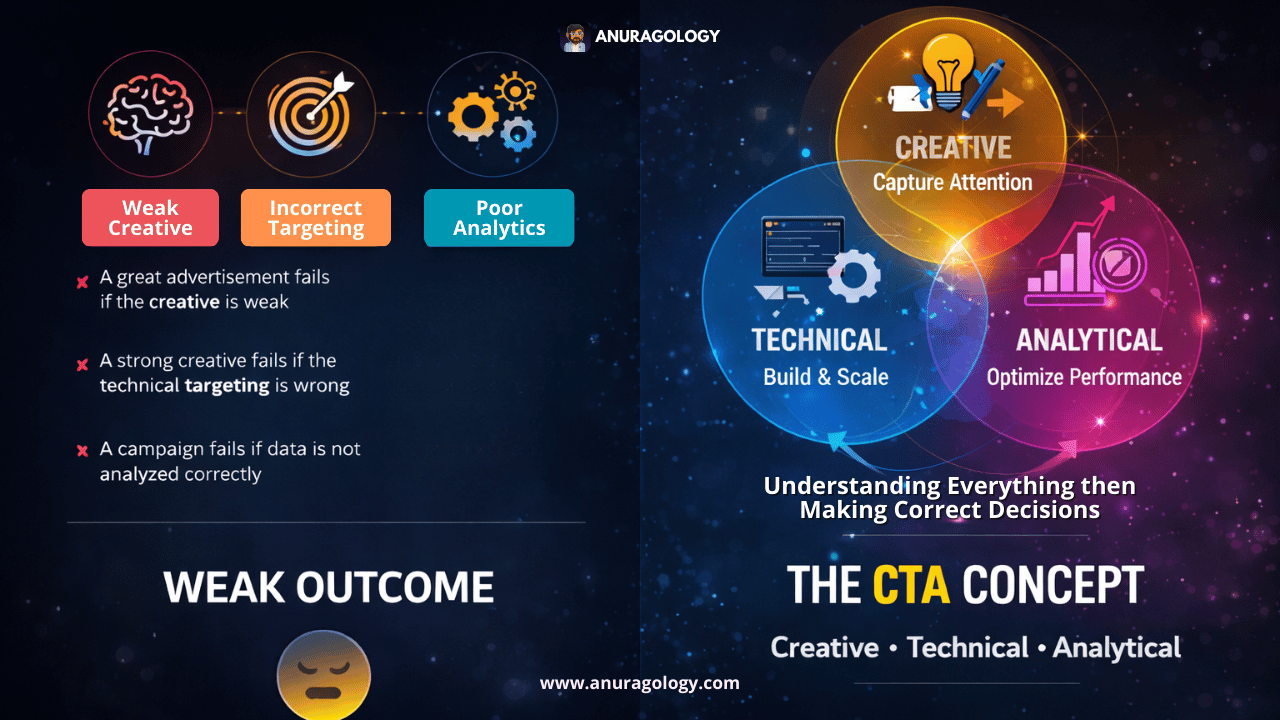
For example:
A great advertisement fails if the creative is weak. A strong creative fails if the technical targeting is wrong. A campaign fails if data is not analyzed correctly.
Modern marketing is not just about tools.
It is about systems thinking.
And this is exactly where the CTA Concept becomes useful.
The CTA Concept Explained
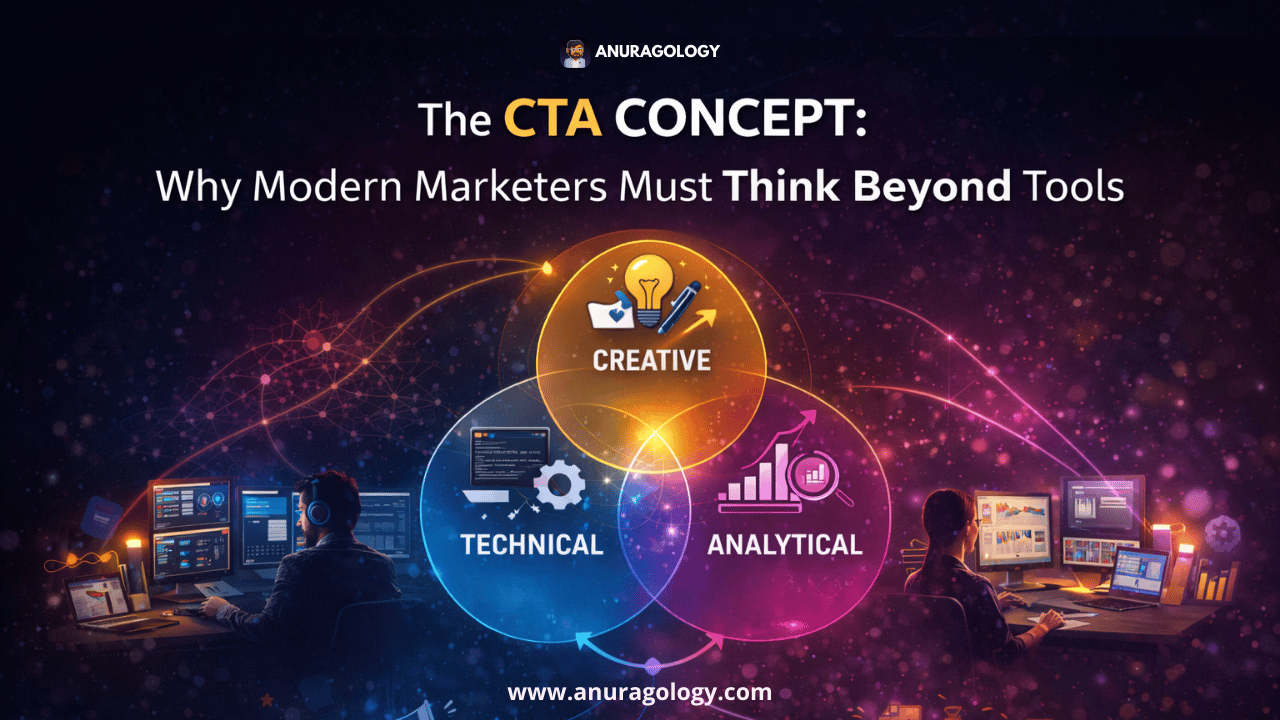
The CTA Concept proposes that every effective marketer needs to develop three core capabilities:
Creative
Technical
Analytical
Each one represents a critical pillar of marketing execution.
When combined, they create a complete growth system.
1. Creative Skills – Capturing Attention
The internet runs on attention.
Before someone clicks, signs up, or buys a product, they first need to notice your message.
Creative skills are what allow marketers to capture that attention.
This includes abilities such as:
- Copywriting
- Content creation
- Visual storytelling
- Graphic design
- Video editing
- Story-driven marketing
Creativity in marketing is not just about making something “look good”.
It is about communicating value in a way that resonates emotionally with people.
Great creatives stop the scroll. They trigger curiosity. They make people want to learn more.
Without creativity, marketing becomes invisible.
2. Technical Skills – Building the Distribution Engine
Creativity alone cannot scale a business.
Even the best marketing message needs distribution infrastructure.
Technical skills allow marketers to build that infrastructure.
This includes areas like:
- Search Engine Optimization (SEO)
- Performance advertising (Google Ads, Meta Ads, LinkedIn Ads)
- Landing page development
- Marketing automation
- Email systems
- CRM integration
- conversion tracking
These skills form the engine behind growth campaigns.
They allow marketers to:
- reach the right audience
- scale campaigns efficiently
- automate repetitive processes
- build reliable marketing funnels
A creative message without technical execution is like a powerful engine without wheels.
3. Analytical Skills – Understanding What Works
Marketing without analytics is guesswork.
Analytical skills help marketers understand what is actually working and what needs improvement.
This includes capabilities like:
- interpreting marketing data
- analyzing campaign performance
- studying audience behavior
- understanding conversion rates
- evaluating CAC and ROI
Analytics answers critical questions such as:
- Which campaign is profitable?
- Where are users dropping off in the funnel?
- Which audience segment converts best?
Data transforms marketing from trial-and-error into a continuous optimization process.
Why the Three Pillars Must Work Together
Individually, each of these skills is powerful.
But the real strength comes from their combination.
A marketer who understands creative, technical, and analytical systems becomes capable of managing entire growth loops.
For example:
Creative thinking helps design compelling campaigns.
Technical execution ensures those campaigns reach the right audience.
Analytical insight allows the marketer to improve future campaigns.
This combination creates what I often call a Full-Stack Digital Marketer.
The Rise of the Full-Stack Digital Marketer
Startups and modern companies increasingly look for professionals who can operate across multiple domains.
Instead of hiring separate teams for every small task, they need marketers who understand the entire growth ecosystem.
A Full-Stack Digital Marketer can:
- design marketing campaigns
- build landing pages
- run paid advertising
- analyze performance data
- optimize the marketing funnel
This type of professional is extremely valuable because they can connect strategy with execution.
Where AI Fits into the CTA Concept
With the rise of AI tools, marketing execution has become faster than ever.
AI can now assist with:
- generating content
- designing images
- writing ad copy
- analyzing datasets
- building prototypes
However, AI does not replace the CTA framework.
Instead, it amplifies it.
AI helps execute tasks faster, but the marketer still needs:
Creative thinking to design the strategy.
Technical understanding to build the system.
Analytical reasoning to evaluate results.
AI is a multiplier — not a replacement.
The Bigger Idea Behind the CTA Concept
The CTA Concept is not just about learning marketing tools.
It is about developing a systems mindset.
Today, the biggest challenge for beginners is not the lack of information — it is the overload of information. There are hundreds of tools, platforms, strategies, and courses available online. Many people get confused about what exactly they should learn and in what order.
This is where the CTA Concept becomes useful.
Instead of trying to learn everything randomly, the framework helps you organize your learning into three clear pillars:
- Creative Skills – generating ideas, storytelling, content creation, and designing messages that capture attention.
- Technical Skills – building the systems that distribute those ideas through websites, ads, automation, and marketing infrastructure.
- Analytical Skills – understanding the data behind campaigns and improving performance through insights and optimization.
Once you understand this structure, it becomes easier to prioritize what to learn. Every marketing skill you encounter will fall into one of these three categories.
The internet economy rewards people who understand how ideas, technology, and data interact with each other.
Creative thinking generates ideas.
Technical systems distribute those ideas.
Analytical insight improves those systems over time.
Together, they create sustainable growth systems.
Another powerful advantage of understanding the CTA framework is team management.
In real-world companies, these three functions are often handled by different people or teams:
- creative teams design campaigns and content
- technical teams handle platforms, ads, websites, and automation
- analytics teams analyze performance and optimize strategy
If a leader understands only one of these areas, communication gaps often occur.
But when you understand all three pillars, you can coordinate these teams much more effectively. You may not personally execute every task, but you understand how each piece fits into the overall marketing system.
This makes it easier to:
- plan better campaigns
- guide team members with clarity
- identify problems quickly
- build more efficient marketing workflows
In other words, the CTA Concept helps marketers move beyond being just task executors and become system thinkers who can design and manage entire growth engines.
And that is the real purpose behind this framework.
Final Thoughts
Digital marketing is no longer a narrow skill set.
It is a multidisciplinary field that combines creativity, technology, and data.
The CTA Concept provides a simple framework to understand this reality.
If you want to become a high-impact marketer, focus on developing capabilities across all three pillars:
Creative skills to capture attention.
Technical skills to build distribution systems.
Analytical skills to optimize performance.
When these elements work together, marketing becomes more than just promotion.
It becomes a growth engine for businesses.
Want to master the CTA Concept?
If you want to become a full-stack digital marketer who understands Creative, Technical, and Analytical systems, explore the learning programs at Anuragology.
I teach the CTA Concept with practical frameworks, real-world case studies, and implementation-focused training designed for modern marketers and entrepreneurs.
Check Now - https://www.anuragology.com/courses