
Let’s be real for a second. If you’re a digital marketer, you already know how to sell. You understand user psychology, you write copy that converts, and you know how to run ads that print money. But for years, when it came time to actually build the custom e-commerce experience you pictured in your head, you hit a technical wall.
You either had to settle for a rigid, cookie-cutter theme that looked like everyone else’s, or you had to pay an agency a fortune to build a custom headless storefront.
For the digital marketers, developers, and builders reading this on Anuragology, the rules have completely changed.
We are officially in the era of Vibe Coding. You no longer need to memorize thousands of lines of React boilerplate or cry over database migrations. Instead, you act as the director. You use AI tools to generate, orchestrate, and deploy the code while you focus on the architecture, the user journey, and the "vibe."
Here is the ultimate technical blueprint for a Full-Stack Digital Marketer to build a hyper-converting, lightning-fast e-commerce platform today, with a realistic look at the tools available.
🧠 System Insights: Anatomy of a Modern E-Commerce Platform
Before touching a single tool, you need to understand the architecture. Modern e-commerce relies on a Headless Architecture, meaning the front-end (what the user sees) is completely decoupled from the back-end (where the data and logic live).
A scalable e-commerce system is broken down into four core pillars:
- The Storefront (Presentation Layer): The blazing-fast UI where users browse, search, and interact. It needs to load in milliseconds for optimal SEO and conversion.
- The Commerce Engine (Business Logic): The API-driven brain handling the shopping cart, checkout flow, tax calculations, and inventory management.
- The Discovery Layer (Search & AI): The algorithms handling semantic search, vector databases, and real-time product recommendations.
- The Data & Auth Layer (Storage): Where user profiles, order history, and custom behavioral analytics are securely stored.
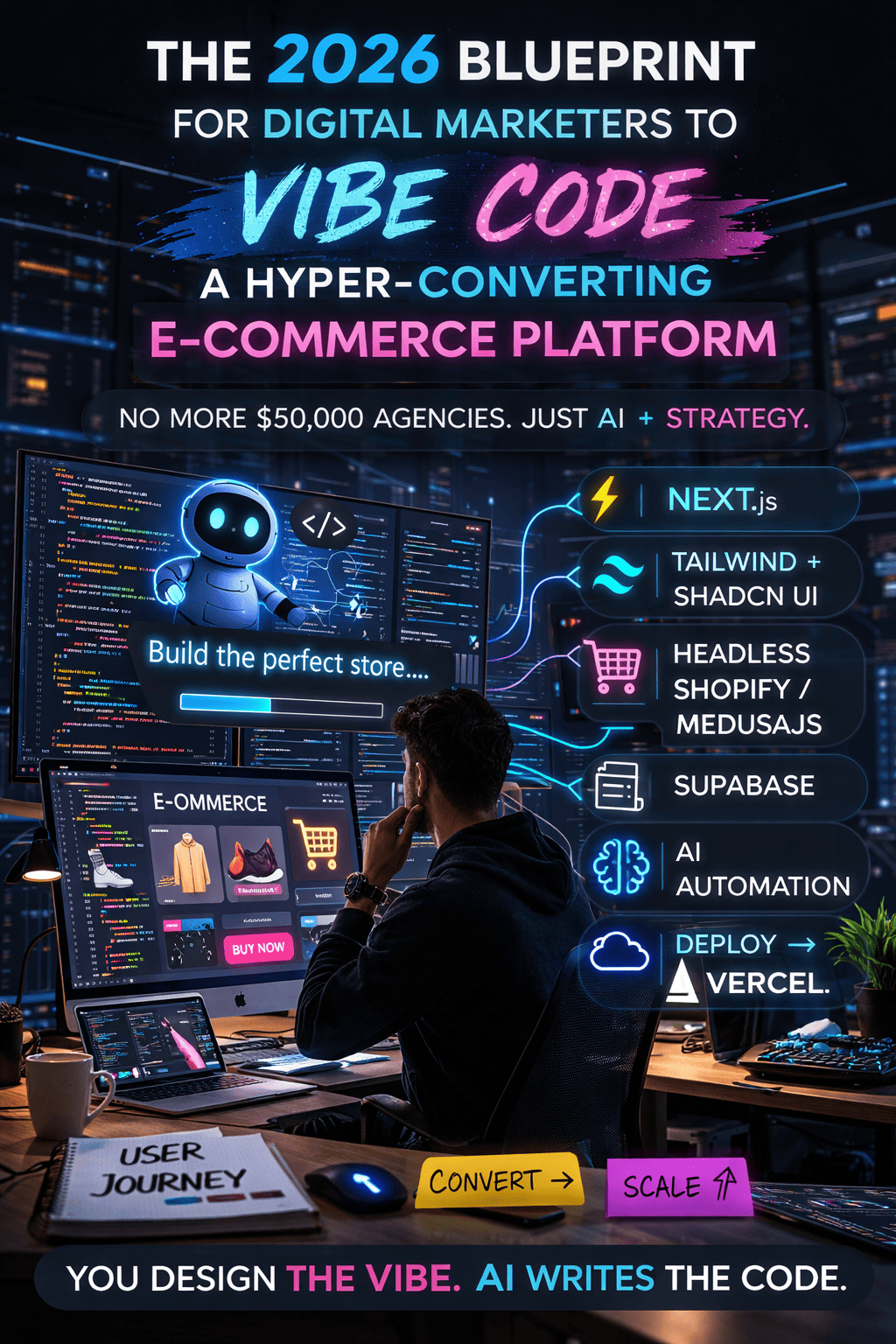
🛠️ The E-Commerce Tech Stack (For Vibe Coders)
To vibe code effectively, you need a stack that AI understands perfectly, delivers the performance modern SEO demands, and is accessible in your region. Here are the types of tools you can piece together:
1. The AI IDE (Your Lead Developer)
You aren't writing code in a standard, empty text editor anymore. You are using AI-native development environments. Tools like Cursor, GitHub Copilot, or Antigravity act as your pair programmer.
How it works: You simply type, "Build me a hero section with a dynamic video background, a glassmorphism add-to-cart button, and tie it to my global state," and watch the AI write the component across your files in seconds.
2. The Frontend & Hosting (The Vibe & Speed)
- The Framework: Next.js remains a powerhouse for this. It gives you server-side rendering (SSR) out of the box, which means your site loads instantly and search engine crawlers can index it perfectly. Pair it with Tailwind CSS and copy-paste component libraries like Shadcn UI so you never have to write custom CSS from scratch.
- The Hosting: When you are ready to put this on the internet, platforms like Vercel are incredible. They offer seamless integration with Next.js, deploy your site to a global Edge network, and the best part—it is completely free for your MVP phase.
3. The Commerce Engine (The Brains)
You need an engine to handle the heavy lifting of transactions without dictating your frontend design.
- Managed Headless: You can use the Shopify Storefront API to handle payments, inventory, and shipping through a bulletproof backend, while keeping total freedom over your custom Next.js frontend.
- Open-Source Alternatives: If you want 100% control and zero platform fees, API-first open-source engines like MedusaJS are incredibly powerful and plug right into a vibe-coded frontend.
4. Database & Auth (The Memory)
You need a place to store user wishlists, reviews, and custom analytics. When choosing a backend-as-a-service (BaaS), regional availability is key (for instance, certain services like Supabase can face ISP blocking issues in India).
- Globally Accessible Alternatives: Look into robust, globally accessible platforms like Firebase (Google's ecosystem), Appwrite (a fantastic open-source alternative), or even spinning up a managed PostgreSQL database on AWS or DigitalOcean if you want total ownership of your data infrastructure.
📈 Why This Blueprint Wins
Why go through the effort of vibe coding this instead of just using a standard drag-and-drop builder?
| Feature | The Old Way (Standard Builders) | The Vibe Coder Way (Headless) |
| Page Speed | Bloated with plugins; slow Core Web Vitals. | Millisecond load times (served via Edge networks). |
| SEO Control | Restricted to basic meta tags and clunky URL structures. | Ultimate control over programmatic SEO and dynamic sitemaps. |
| A/B Testing | Requires heavy third-party scripts that cause visual flickering. | Handled at the edge/server level for zero-flicker personalization. |
| Flexibility | "Sorry, the theme doesn't support that layout." | "Hey AI, rewrite this UI component to look exactly like Apple's site." |
📦 Applying the Blueprint: Building AnWrap
When mapping out the development of AnWrap, our own e-commerce initiative, we knew a standard template wouldn't cut it. We needed heavy personalization, advanced search discovery, and a checkout flow optimized specifically for our audience.
By leaning heavily into the Vibe Coding philosophy—using a fast frontend framework, plugging into robust APIs for backend logic, and relying on AI to rapidly iterate UI components—we mapped out a platform that feels incredibly premium. It shifts the workload: you spend 20% of your time "coding" and 80% of your time tweaking the user psychology, conversion flows, and marketing hooks.
🚀 The Mindset Shift
As a digital marketer, your greatest asset is your understanding of the customer journey. Code is simply the medium to make that journey happen.
Stop thinking of yourself as someone who "doesn't know how to code." Start thinking of yourself as a Product Manager with an AI engineering team at your fingertips. Learn how to write great prompts, understand how APIs talk to each other, and focus on the system architecture. The AI will handle the syntax.